Short answer
Matcha powder is shade-grown green tea leaf ground fine and sold in tins or pouches. Choose a vivid green powder with a fresh, sweet smell, store it airtight and cool, and sift it before whisking or blending.
Matcha powder is shade-grown green tea leaf ground to a very fine powder and sold in tins or pouches. To choose a good one, look for a vivid green colour, a fresh sweet smell and a clear label with the origin and harvest information. Store it airtight and cool, sift it, and whisk or blend it into water or milk.
What should matcha powder look and smell like?
Good matcha powder is a bright, lively green with a fresh, sweet, slightly grassy smell. Dull olive, yellow or brown tones and a hay-like smell suggest older powder or lower quality leaf.
Look at the powder in natural light if you can. Fresh matcha is very fine and almost silky between the fingers. Coarse, gritty powder tends to taste harsher and mixes less smoothly.
How do you choose matcha powder?
Choose matcha powder by checking colour, origin, grade wording, harvest information and pack size. A small tin you will finish quickly beats a large one that sits open for months.
| What to check | Good sign | Warning sign |
|---|---|---|
| Colour | Vivid green | Dull, yellow or brown |
| Smell | Fresh, sweet, grassy | Stale, dusty or hay-like |
| Ingredients | Only green tea leaf | Added sugar, flavours or fillers |
| Origin | Region and producer named | No origin stated at all |
| Packaging | Sealed tin or foil pouch | Clear jar in a bright window |
| Size | Quantity you will use soon | Very large bag, opened for months |
Prices vary widely between brands and are not a reliable guide on their own. Origin in Japan, such as Uji or Nishio, is often a mark of traditional production, but good powder is also made in other places.
What is the difference between ceremonial and culinary matcha powder?
Ceremonial grade matcha powder is meant to be whisked with water and drunk plain, while culinary grade is meant for lattes, baking and cooking. The terms are marketing labels, not a legal standard, so they differ from brand to brand.
Ceremonial grade is usually smoother, sweeter and brighter green. Culinary grade is stronger and slightly more bitter, which holds up under milk and sugar. A cafe-style latte at home is a good use of a culinary or everyday grade.
How do you store matcha powder?
Store matcha powder in an airtight container away from light, heat and moisture. Many people keep the opened tin in the refrigerator and bring it to room temperature before opening it.
- Keep the original tin or move the powder to a small airtight container.
- Press out as much air as you can if it comes in a foil pouch.
- Keep it away from the stove, windows and strongly scented foods.
- Bring a cold tin to room temperature before opening, so condensation does not form.
- Use an opened tin within a couple of months for the best flavour.
Matcha absorbs smells easily, so keep it away from spices and coffee beans.
How do you use matcha powder?
You use matcha powder by sifting it, adding a small amount of water, whisking until smooth, and then adding more water or milk. The same method works hot or iced.
- Sift 1 to 2 grams of powder into a bowl.
- Add about 30 ml of water at 70 to 80 degrees Celsius.
- Whisk in a quick zigzag or W motion until the surface is covered with fine foam.
- For a latte, pour the matcha over warm or cold milk. For an iced drink, pour over ice.
- Sweeten to taste if wanted. Simple syrup mixes better in cold drinks than granulated sugar.
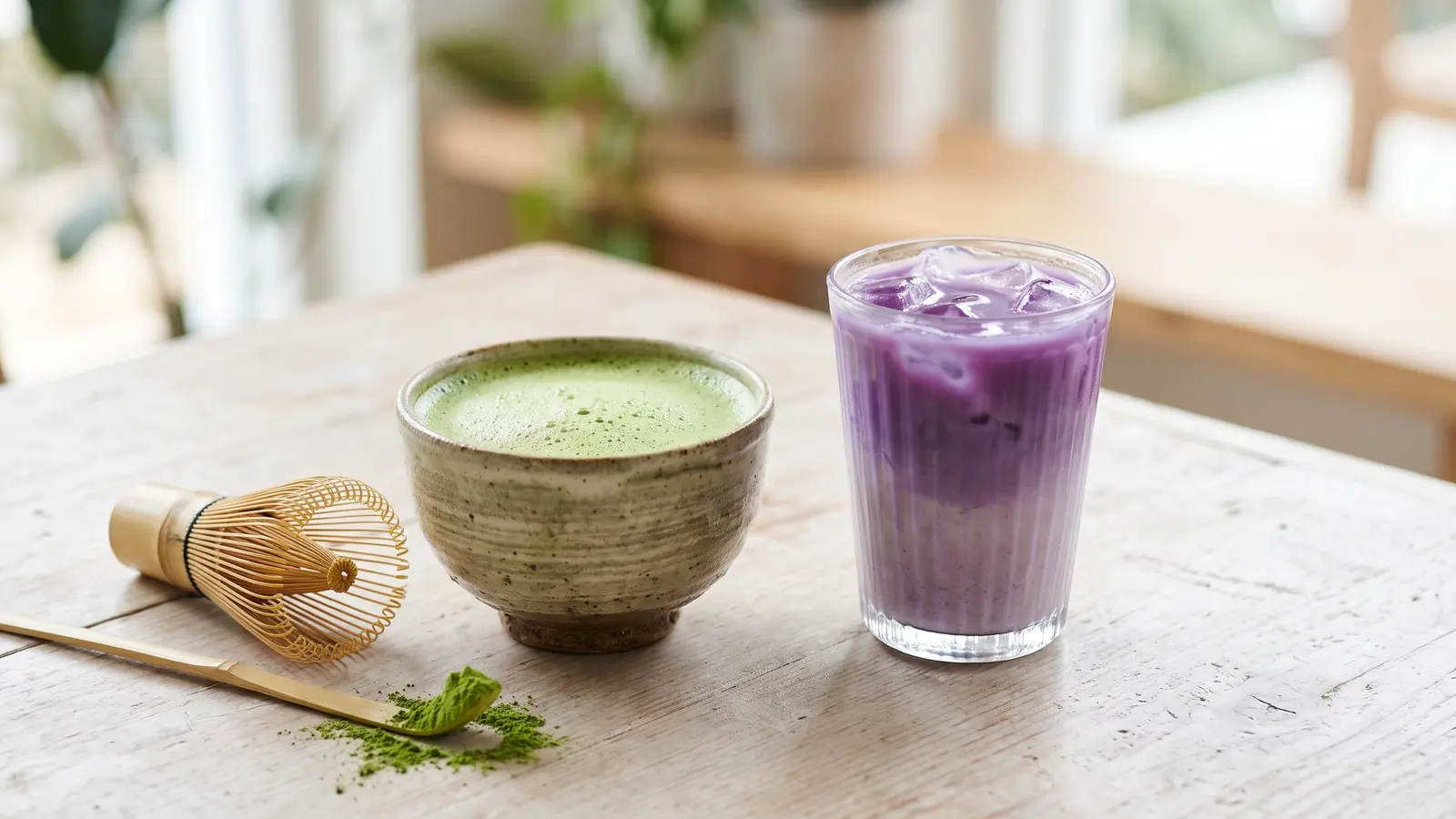
A bamboo whisk makes the best foam, though a handheld frother will do the job.
What can you make with matcha powder?
Matcha powder goes into lattes, iced drinks, smoothies, baked goods, ice cream, whipped cream and sweet sauces. Its flavour pairs well with milk, cream, white chocolate, strawberries and sesame.
- Drinks: hot or iced lattes, matcha with fruit purees, sparkling matcha with soda water.
- Baking: shortbread, cakes, cookies, muffins and cheesecake.
- Sweets: ice cream, mochi, panna cotta and no-bake bars.
When baking, culinary grade is usually enough. Heat and sugar soften the delicate notes that finer powder is prized for.
How much matcha powder do you need?
You need about 1 to 2 grams of matcha powder for one small bowl of tea, and a little more for a milk drink. A level half teaspoon is close to 1 gram, though the weight varies with how finely the powder is packed.
| Drink | Powder | Liquid |
|---|---|---|
| Thin tea in a bowl | 1 to 2 g | 70 to 80 ml hot water |
| Hot latte | 2 g | 150 to 200 ml steamed milk |
| Iced latte | 2 to 3 g | 30 ml water plus 150 ml cold milk and ice |
| Baking batch | 1 to 2 tablespoons | Follow the recipe |
A small digital scale is the most reliable way to repeat a drink you like. If a drink tastes bitter, use a little less powder before changing anything else.
What is the difference between matcha powder and green tea powder?
Matcha powder is made from shaded leaves that are steamed and stone-ground, while generic green tea powder may be made from ordinary leaves. Matcha is brighter in colour and smoother in taste.
Always read the ingredient list. Some blends add sugar, milk powder or flavouring, and these are sold as instant lattes rather than pure matcha. Pure matcha lists one ingredient, green tea leaf.
Is matcha powder on Café 2nd Gen’s menu?
Matcha powder as a retail product is not on the recorded menu for Café 2nd Gen, so this guide cannot say whether the cafe sells tins. What is recorded are the matcha drinks.
Sources name the Ube matcha, the Matcha Melona and the Matcha tiramisu, along with a seasonal black sesame foam. No prices have been found. Ask the staff or check the cafe’s Instagram account, @cafe2ndgen, if you want to know what else is available.
The menu page lists the items recorded for this guide, and the hours and location page has the address on Rue William. This guide is independent and takes no orders.
Common questions
How much matcha powder do you use per cup?
A common starting point is 1 to 2 grams, about half to one teaspoon, for a 70 to 80 ml serving whisked with water. For a latte, many people use around 2 grams in 200 ml of milk.
Can matcha powder go bad?
Matcha does not spoil quickly, but it fades. Over weeks and months an opened tin turns duller in colour and flatter in smell and taste. Check the date on the pack and use it while it still smells fresh.
Is matcha powder the same as green tea powder?
Not always. True matcha is made from shaded leaves and ground whole. Some products labelled green tea powder are ground from ordinary sun-grown leaves, so they are duller in colour and more bitter.
Do you need a whisk to use matcha powder?
No. A bamboo whisk gives the finest foam, but a small handheld frother, a jar with a tight lid, or a blender can mix the powder into water or milk well enough for a latte.
Why does my matcha powder clump?
Fine powder clumps from static and moisture. Pushing it through a small sieve before adding liquid breaks the clumps. Adding a splash of water first and mixing to a paste also helps.
For the address, opening hours and menu, see Café 2nd Gen in Montréal.
This article is general information from an independent guide, not from Café 2nd Gen itself. For the store’s current details see hours and location.